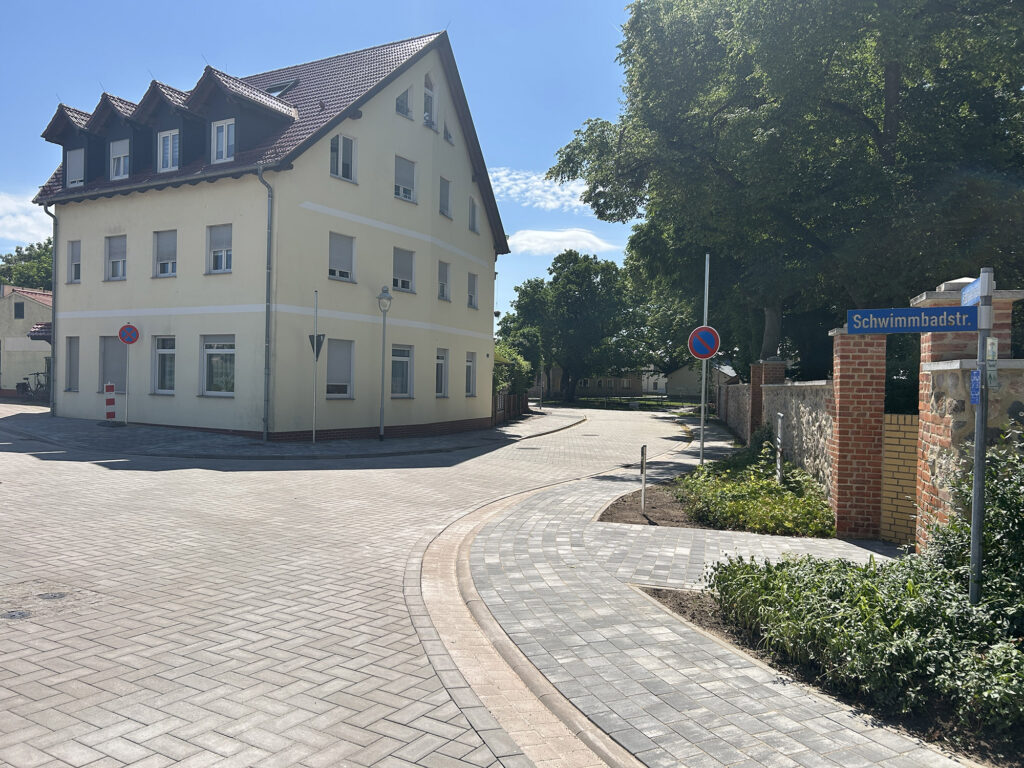



The intersection of Schwimmbadstraße, Fabrikstraße, and Heinrich-Heine-Straße will reopen on Wednesday
A major milestone in the Heinrich-Heine-Straße construction project has been reached: On Tuesday, June 23, the partial inspection took place, and on Wednesday, June 24, Fabrikstraße and the intersection of Schwimmbadstraße, Fabrikstraße, and Heinrich-Heine-Straße will be reopened to traffic. This means that Fabrikstraße and Schwimmbadstraße are once again fully open to traffic. Heinrich-Heine-Straße is once again accessible up to the DRK entrance.
Over the past few months, this area has undergone a complete renovation. The city of Wolmirstedt renewed the streets, sidewalks, and street lighting. WWAZ installed the wastewater, stormwater, and drinking water pipes, and the municipal utilities laid electrical and district heating lines. The same work is now scheduled to take place during the next phases of this major construction project.
Work is currently underway in the area between the intersection of Schwimmbadstraße, Fabrikstraße, and Heinrich-Heine-Straße and Meseberger Straße, including the cul-de-sac on Friedrich-Ebert-Straße. The utility lines have been laid there (sewage, stormwater, drinking water, lighting cables, and power lines). Paving work is now beginning, and curbs are being installed.
At the same time as the intersection of Schwimmbadstraße, Fabrikstraße, and Heinrich-Heine-Straße reopens—that is, on Wednesday—the intersection of Meseberger Straße and Heinrich-Heine-Straße will be closed. Around mid-July, Heinrich-Heine-Straße is scheduled to be closed up to the intersection with Samsweger Straße. Access to the parking lot of the new Aldi store will then be possible from Geschwister-Scholl-Straße.
The entire construction project, which will later include the intersection of Heinrich-Heine-Straße and Samsweger Straße as well as a section of Lindhorster Weg, is expected to last until April 2027. The city’s portion of the work will cost approximately 2.5 million euros, with one-third funded by federal funds, one-third by state funds, and one-third borne by the city.